
Article By Frank Bergman
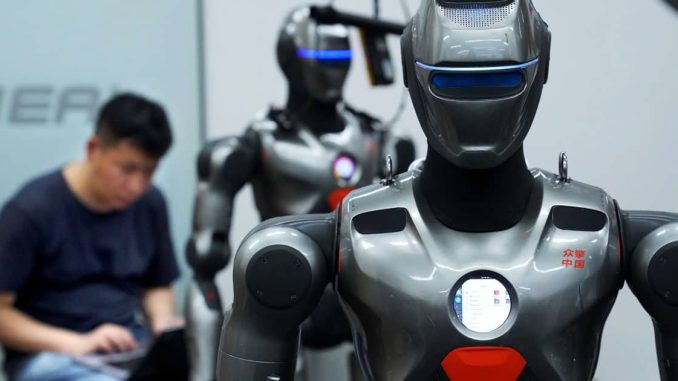
Communist China’s military is rapidly developing humanoid robot “combatants” for deployment on the battlefield as Beijing races toward a chilling new era of machine warfare.
While China’s humanoid robots have been publicly displayed sprinting, jumping, dancing, and competing in sporting events, behind the scenes the Chinese Communist Party’s military is working to turn the technology into weapons of war.
The People’s Liberation Army (PLA) is accelerating research into deploying humanoid robots alongside human troops and ultimately expanding their role from battlefield support to direct combat.
The push raises the prospect of future battlefields dominated by autonomous machines, drones, and robotic soldiers capable of identifying and attacking human targets.
A major investigation by Reuters uncovered the scale of China’s preparations after examining more than 100 Chinese military procurement notices, patents, academic studies, government records, official publications, and defense industry materials.
“China’s defense establishment is accelerating research into humanoids’ military uses and planning for their eventual wartime deployment, according to a Reuters review of more than 100 Chinese military procurement notices, academic studies, patents, official publications, government records and defense-company materials,” Reuters reported.
China’s Robot ‘Combatants’ Move Toward the Battlefield
The military effort accelerated significantly during 2025 and 2026.
Chinese military institutions are testing humanoids against battlefield requirements while seeking robots and related technology for training.
Researchers are concentrating on capabilities including perception, manipulation, movement, and the enormous quantities of training data needed for machines to operate in unpredictable combat environments.
The PLA’s official newspaper has openly urged researchers to move advanced robotics out of laboratories and onto military training grounds.
The machines are being described as robotic “combatants.”
That development comes shortly after China’s World Humanoid Robot Games offered international governments a demonstration of just how quickly the country’s robotics industry is advancing.
The machines competed in events involving running, jumping, and other complex movements that would have been extraordinarily difficult for humanoid robots only years ago.
China also possesses an enormous industrial advantage.
Chinese manufacturers accounted for approximately 95% of worldwide humanoid robot shipments in 2025, according to BofA Global Research.
That commercial dominance provides Beijing’s military with access to a rapidly expanding domestic robotics industry as it develops battlefield applications.
PLA Envisions Robots Moving to ‘Primary Combat’
China’s military is not limiting its ambitions to robots carrying ammunition or evacuating wounded soldiers.
PLA commentary has explicitly discussed moving humanoid machines into direct fighting roles.
A July 2025 article published in PLA Daily predicted that humanoid missions could eventually evolve “from supporting combat toward primary combat.”
The article even examined circumstances in which a robot could be authorized to fire on a living target after that person had been verified by a human.
That represents a profound escalation from today’s battlefield robotics.
“Going where we don’t want humans to go is one of the most compelling reasons to develop robots in the first place,” UCLA mechanical and aerospace engineering professor Dennis Hong said.
“If losing a robot means avoiding the loss of a human life, then the robot can become expendable.”
Unlike human soldiers, armies of machines do not need families to be told their loved ones were killed.
They do not tire in the same way, and commanders could send them into environments considered too dangerous for troops.
Once produced at scale, they could also fundamentally change the economics and tempo of warfare.
‘Fully Autonomous Humanoid Robot Combat’
The technology is already advancing beyond laboratory demonstrations.
Chinese robotics giant Unitree released a video Monday showcasing what the company called “Fully Autonomous Humanoid Robot Combat.”
WATCH:
China is testing humanoid robots for jobs far beyond factories.
— Techniahqrobot | humanoid robots (@techniahqrobot) August 18, 2026
At the World Robot Conference in Beijing China Ordnance is showing its Fuxi humanoid robotdesigned for security and emergency response tasks. https://t.co/8YptW2f50R pic.twitter.com/zv3PzBNtCa
China is not alone in pursuing the technology.
American humanoid robotics company Foundation has also been testing robots for military applications.
Meanwhile, the war between Russia and Ukraine has already demonstrated how rapidly unmanned systems can transform combat.
Semiautonomous drones equipped with artificial intelligence are being used for reconnaissance and attacks, while ground robots transport supplies and retrieve casualties.
The PLA has been closely studying lessons from that conflict.
Humanoid robots could represent the next stage of the same transformation.
Rather than machines simply flying toward targets or carrying equipment across terrain, humanoid systems could eventually perform tasks previously requiring soldiers.
Machines Could Decide Who Lives and Dies
The prospect becomes even more alarming as artificial intelligence is increasingly integrated into targeting systems.
A remotely controlled robot ultimately remains under direct human command.
An autonomous machine presents an entirely different problem.
The laws of war require military forces to distinguish civilians from combatants and recognize when wounded or surrendering fighters can no longer legally be attacked.
Those decisions can depend on subtle human behavior, context, and intent.
The International Committee of the Red Cross has warned that autonomous weapons may struggle to reliably interpret signs of surrender.
That means the accelerating race toward autonomous warfare raises a terrifying question: What happens when a machine must decide whether the human standing in front of it lives or dies?
Rise of the Machines
The prospect of “Skynet-like” warfare is no longer confined to science fiction.
Humanoid robots are advancing alongside one-way attack drones, unmanned ground vehicles, artificial intelligence targeting systems, and increasingly automated military kill chains.
China is now openly preparing for robotic “combatants” and studying how their missions could move “from supporting combat toward primary combat.”
The machines demonstrated at sporting events today could become the battlefield systems of tomorrow.
And once nations begin deploying armies of expendable machines capable of fighting alongside, or eventually instead of, human soldiers, there may be no putting that technology back in its cage.
The rise of the machines is rapidly moving from science fiction toward military reality.












Be the first to comment