
Article By Frank Bergman
The globalist World Health Organization (WHO) is demanding that governments around the world join forces to impose a sweeping online lockdown that would restrict access to social media through digital ID age checks.
The plan is being sold as a child safety measure.
In reality, it would force ordinary Internet users into identity checkpoints before they can access major online platforms.
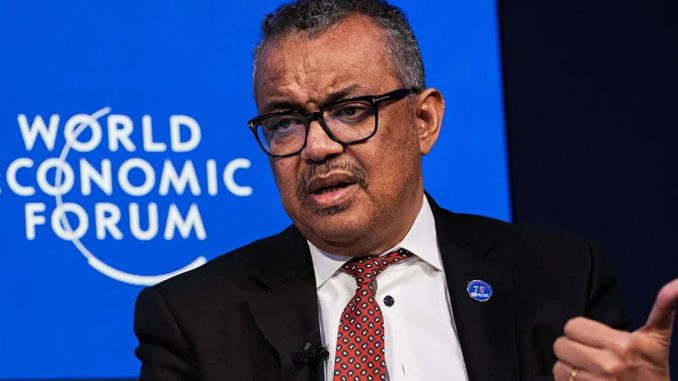
World Health Organization Director-General Tedros Adhanom Ghebreyesus published a statement calling for mandatory age checks, legally mandated platform redesigns, and “safety-by-design” rules across the democratic world.
The statement was written in collaboration with French President Emmanuel Macron, who called on other world leaders to join him.
The joint statement recasts social media, gaming, and generative AI as forces acting directly on the bodies and minds of children.
That framing gives governments the opening they need to regulate who is allowed online.
“These measures reflect a growing global consensus that digital environments require effective governance, age-appropriate design, and stronger safeguards to protect child health,” Tedros and Macron wrote.
The language sounds harmless.
The mechanism is not.
Mandatory Age Checks Mean Identity Checks
Age verification requires identity verification.
To confirm that a user is old enough to access a platform, a company must first determine who that user is.
That means matching a claimed birthday against a face scan, a credit record, a government ID, or another identity-linked database.
An ordinary social media login becomes an identity checkpoint.
A system marketed as a way to keep children off certain platforms becomes a system that catalogs adults who remain on them.
No platform can verify the age of teenagers without also checking the age of every other user.
That is the central danger behind the WHO-backed plan.
The proposal would push every social media user toward linking a digital identity to an online account in order to unlock access.
Those who refuse risk being excluded from the platforms that now function as public squares, news distribution systems, business tools, and political communication networks.
The Internet would no longer be open by default.
It would require permission from global authorities.
Global Leaders Frame Surveillance as Protection
Tedros and Macron frame the plan as protection, not surveillance.
They describe digital spaces as determinants of health, placing them alongside issues such as clean water and safe housing.
They warn that infinite scrolling, autoplay, push notifications, gaming systems, and generative AI are engineered to keep young users hooked.
“Solutions are needed because digital environments are not neutral,” they wrote.
That claim is the gateway to control.
Once digital spaces are treated as health environments, governments can claim sweeping power to regulate access, design, speech, identity, and participation.
The two leaders even identify the danger of data collection in their own statement.
“The collection and use of personal data, particularly for profiling and targeted marketing, raise concerns about privacy, manipulation, and well-being,” the statement reads.
Their solution is to create age-assurance regimes that require platforms to gather more identifying data from more people.
That would hand corporations and governments a new justification to know exactly who is behind every account.
The contradiction is glaring.
They warn that personal data can be abused while demanding a system that expands the collection of personal data.
Governments Are Already Building the Gates
The WHO-backed push is not theoretical.
Governments are already building the infrastructure for online access control.
Australia now bars anyone under 16 from holding a social media account, making it the first national ban of its kind.
France is pushing legislation to lock out users under 15.
Indonesia has banned access for children under 16.
Spain has announced plans to follow.
Ireland is working with European Union partners on age-assurance systems aimed at under-16s.
The United Kingdom intends to block platforms from serving under-16s while adding limits on livestreaming and contact from strangers.
Canada has introduced legislation to restrict access for children under 16 and impose stronger safety-by-design duties on platforms.
The same blueprint is spreading across the West.
Each country presents its version as a child protection measure.
Together, they form the architecture of a global digital ID regime for online life.
Generative AI Used to Expand Control
Generative AI is being pulled into the same framework.
Tedros and Macron argue that AI multiplies the risks facing young people.
They warn that its long-term effects on empathy, self-regulation, and children’s expectations of real relationships remain unclear.
“…a precautionary approach is not anti-innovation. It is pro-child,” they wrote.
But precaution becomes surveillance when the enforcement tool is mandatory identity verification.
A government does not need to ban everyone from a platform if it can force every user to prove their identity before entering.
The control point moves from the content itself to the person trying to access it.
That is why the child safety justification is so powerful.
It allows governments to build systems that begin with minors and then expand to everyone.
Once the identity gate exists, it can be used for far more than age checks.
It can be used to restrict speech, track political activity, block anonymous accounts, punish dissent, and enforce future speech rules that have nothing to do with children.
Digital ID at the Door
Tedros and Macron insist they are defending children’s dignity.
“Our children and young people are not experimental subjects, a captive market, or a commodity,” they wrote.
That principle should also apply to every citizen being pushed into a digital ID system.
An Internet that demands legal identity at the door treats every user as a suspect.
It also gives the screening power to the same governments and platforms that claim to be protecting the public from manipulation.
The danger is not that children should be protected from harmful online content.
The danger is that global bureaucrats are using children as the moral shield for a system of universal online identification.
Once that system is in place, anonymous speech becomes a privilege granted by the state.
Access to the digital public square becomes conditional.
And every user must prove who they are before they can participate.
The WHO and its political allies are not merely calling for safer platforms.
They are laying the groundwork for a controlled Internet where digital identity becomes the price of entry.












Be the first to comment