
Article By Frank Bergman
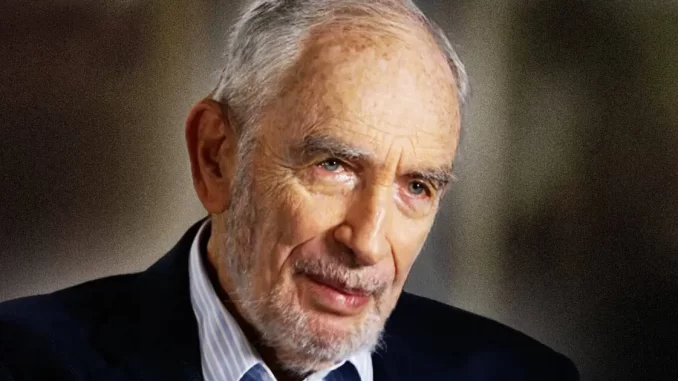
Radical population control advocate Paul Ehrlich, the architect behind the chilling globalist depopulation agenda, has died at age 93 following complications from cancer.
Ehrlich’s death closes the chapter on one of the most controversial figures in modern environmental and demographic debates.
The depopulationist rose to global prominence with his 1968 book “The Population Bomb.”
In the book, he warned of catastrophic overpopulation and mass starvation, creating a narrative that shaped decades of policy discussions around population control.
Dire Predictions That Failed to Materialize
In “The Population Bomb,” Ehrlich issued stark warnings about the future of humanity.
“The battle to feed all of humanity is over,” Ehrlich wrote in the book
“In the 1970s and 1980s, hundreds of millions of people will starve to death in spite of any crash programs embarked upon now.”
“At this late date, nothing can prevent a substantial increase in the world death rate.”
He later escalated those claims in “The End of Affluence” (1974), suggesting that up to a billion people could die from starvation by the mid-1980s.
Those predictions never materialized.
Despite global population growth, from roughly 3.6 billion at the time of his early work to over 8 billion today, famine deaths declined, and food production increased.
The Famous Bet That Undermined His Theory
Ehrlich’s credibility took a major hit following a widely publicized wager with economist Julian Simon.
He argued that overpopulation would drive resource scarcity and rising commodity prices.
Simon disagreed, predicting the opposite.
In 1980, as part of a $1,000 bet, Ehrlich selected five metals: tin, tungsten, copper, nickel, and chrome.
By 1990, the prices had fallen, and Ehrlich paid Simon $576, conceding the loss.
The outcome became a defining example cited by critics who argued that human innovation, not scarcity, drives long-term resource trends.
Advocacy for Aggressive Population Controls
Ehrlich’s writings and public statements frequently called for sweeping and controversial measures to reduce population growth.
In The Population Bomb, he wrote:
“We must have population control at home, hopefully through changes in our value system, but by compulsion if voluntary methods fail.”
He also discussed the possibility of introducing contraceptives into the food supply, dismissing it only as “politically unfeasible.”
In later years, he continued to advocate for large-scale reductions in the human population.
“Society needs rescaling – we’ve got to reduce the size of the entire human enterprise,” Ehrlich said in 2014.
Influence on Policy and Global Movements
Ehrlich was a co-founder of Zero Population Growth, a group focused on reducing population growth and promoting birth control.
The organization credited its efforts with helping drive down U.S. fertility rates from 3.42 children per woman in the early 1960s to 1.8 by 1975.
Despite repeated criticism over failed predictions, Ehrlich remained influential in academic and policy circles.
He held a long-standing position at Stanford University as a professor of population studies and received numerous honors, including:
- A MacArthur Foundation “genius” award
- The Heinz Award for the environment
- The World Wildlife Fund Gold Medal
- Sweden’s Crafoord Prize in biosciences (shared with E. O. Wilson)
- Fellowship in the Royal Society
A Polarizing Legacy
Ehrlich’s legacy remains deeply divisive.
Supporters credit him with raising awareness about environmental limits and population pressures.
Critics argue his predictions were consistently wrong and that his proposed solutions were extreme, often prioritizing population reduction over human welfare and technological progress.
Even as his forecasts failed to come true, Ehrlich continued to be cited as a leading voice in population and environmental debates.
His death marks the end of a career that shaped globalist discussions on depopulation.
Good ridence.












Be the first to comment